Long time no see, eh? TBH, I haven’t really felt like reviewing anything I’ve read recently (though if you’re interested in the things I’ve been reading but not reviewing here, come find me on Goodreads). But I’m breaking my silence to talk about my two favorite YA fantasy series. I’ve been thinking about them a lot recently, partly because I’ve been getting a hankering to re-read them, and partly because I’ve been reading a new series and I can’t help thinking about how it stacks up to my favorites. So here we go:
The Lumatere Chronicles, by Melina Marchetta (1. Finnikin of the Rock, 2. Froi of the Exiles, 2.5 Ferragost, 3. Quintana of Charyn)
Oh, the characters in this series. I love them all so dang much. Marchetta knows how to make her characters seem real and how to get you to see their flaws but care about them anyway. For pete’s sake, she manages to take one of the least likable characters from the first book and make him into the hero of the second two. That’s some skill, right there. And it’s not just the main characters that pull you in. The secondary characters make you care about them just as much, especially in the second two books. Seriously, the relationship dynamics between various family and friends and lovers in those last two books are outstanding. Marchetta also does a fantastic job exploring the gray areas and difficult topics. Nothing is ever easy for her characters, but the strength they gain from their experiences makes you love them all the more.
The Daughter of Smoke and Bone series, by Laini Taylor (1. Daughter of Smoke and Bone, 2. Days of Blood and Starlight, 3. Dreams of Gods and Monsters)
After finishing the first book in this series, I would never have guessed that these books would become some of my favorites. The first book, while it has its strong points, pales in comparison to the second two. It’s actually a bit hard for me to believe that the first book is even in the same series, because that book is all angels! monsters! insta-love! But the story and characters really come into their own in books 2 and 3. It was quite an amazing save, I thought. And this series is pretty epic in scope. I mean, we’re talking about things like the genocide of races and the destruction of worlds, and there are A LOT of plot lines to follow. But Laini Taylor always manages to stay in control of the story—admittedly, sometimes she only manages it by the skin of her teeth, but she always does somehow manage it. Like the Lumatere Chronicles, this series has fantastic characters that worm their way into your heart, but the thing that always stands out to me is the humor. Laini Taylor is just so skilled at working wit and humor into scenes that are otherwise pretty depressing.
Ak. These books. I can’t even. I just love them so much. If you haven’t read them yet, I obviously highly recommend them.
Tuesday, March 17, 2015

Tuesday, February 3, 2015
Review: Love and Other Foreign Words
“Love and Other Foreign Words,” by Erin McCahan. The Goodreads summary:
The story was pretty predictable, but I was too distracted by how amusing it was to really care all that much. I really liked that Josie was close to her family. Even when she’s fighting with her sister, you can still tell that they love each other. And her parents were the greatest. And hilarious. I just really enjoyed the generally un-angsty family dynamic.
But as light and fun as this book is, it also made me think. Josie has this whole theory about how everyone speaks their own “language,” and how different groups speak different “languages,” and you have to learn to speak those languages to be able to communicate with them. (It makes way more sense in the book than how I just explained it, probably). And reading about it made me really grateful for the people in my life who speak my language. The people who speak fluent Karen. Like Josie, I feel like I’ve learned to translate other people’s languages pretty well, but it’s always such a relief when I find those people who I can talk to without the translation step because, like Josie says, “it is impossible to be fully yourself in a foreign language.”
Anyway, since this review has descended into rambling, I’ll wrap it up.
Overall, a thoroughly entertaining book with a main character that I wouldn’t mind being friends with in real life.
Rating: 3.5 / 5
I grinned my way through this book. There’s no other way to describe it. Josie just cracks me up. From the summary, I thought I was going to find her annoying (the whole trying to break up her sister’s wedding thing seemed like it was going to be a bit much), but she didn’t annoy me at all. Probably because when you’re inside Josie’s head, you can totally see why she hates her sister’s fiancé.Sixteen-year-old Josie lives her life in translation. She speaks High School, College, Friends, Boyfriends, Break-ups, and even the language of Beautiful Girls. But none of these is her native tongue -- the only people who speak that are her best friend Stu and her sister Kate. So when Kate gets engaged to an epically insufferable guy, how can Josie see it as anything but the mistake of a lifetime? Kate is determined to bend Josie to her will for the wedding; Josie is determined to break Kate and her fiancé up. As battles are waged over secrets and semantics, Josie is forced to examine her feelings for the boyfriend who says he loves her, the sister she loves but doesn't always like, and the best friend who hasn't said a word -- at least not in a language Josie understands.

The story was pretty predictable, but I was too distracted by how amusing it was to really care all that much. I really liked that Josie was close to her family. Even when she’s fighting with her sister, you can still tell that they love each other. And her parents were the greatest. And hilarious. I just really enjoyed the generally un-angsty family dynamic.
But as light and fun as this book is, it also made me think. Josie has this whole theory about how everyone speaks their own “language,” and how different groups speak different “languages,” and you have to learn to speak those languages to be able to communicate with them. (It makes way more sense in the book than how I just explained it, probably). And reading about it made me really grateful for the people in my life who speak my language. The people who speak fluent Karen. Like Josie, I feel like I’ve learned to translate other people’s languages pretty well, but it’s always such a relief when I find those people who I can talk to without the translation step because, like Josie says, “it is impossible to be fully yourself in a foreign language.”
Anyway, since this review has descended into rambling, I’ll wrap it up.
Overall, a thoroughly entertaining book with a main character that I wouldn’t mind being friends with in real life.
Rating: 3.5 / 5
Monday, January 19, 2015
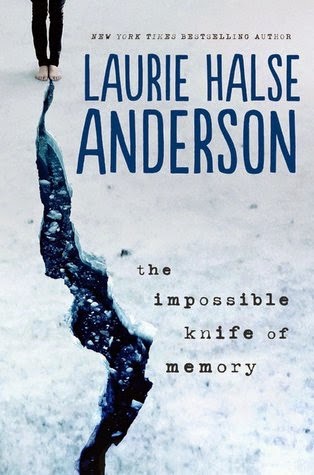
Review: The Impossible Knife of Memory
“The Impossible Knife of Memory,” by Laurie Halse Anderson. The Goodreads summary:
I’m actually not sure how to really go about writing a review for this book. So much of the story revolves around Hayley’s dad’s PTSD and how it affects pretty much every aspect of their lives. It was just so intense and painful to read about that I don’t know how to review that aspect of it. So that only really leaves me with Hayley’s other relationships to talk about.
Her best friend, Gracie, was one of those types of friends that crop up in YA, where I’m just like, “Why are you even friends with this person?” I can sympathize with Gracie for having her own screwed up home life, but she and Hayley never really seemed to have any actual friend chemistry.
Hayley’s relationship with Finn was pretty adorable, though. I was just so glad that Hayley found someone in her pretty crappy life that made her happy. Finn was just so . . . buoyant. Whenever Hayley tried to push him down or keep him away he just bounced right back up. I did feel like the author tried a little too hard to give Finn complicated family drama; it just always felt a little forced and not like a real part of the story.
Hayley’s relationship with Trish was one that I wish we could’ve spent more time on. It just had so much potential. As Hayley’s dad’s stateside girlfriend, Trish was never supposed to be Hayley’s mother figure, but then she was . . . until she just walked away, for which Hayley understandably has never forgiven her. And though I feel like Anderson did a good job with their relationship in the time allotted to it as a secondary part of the plot, I wish more time could’ve been spent there because the dynamics fascinated me.
Hayley herself was so strong, if a little rough around the edges and abrasive. Her situation seems impossible, but she deals with it in the best way she knows how. It was hard to watch her constantly push people away and keep them out, but it just made those times she does let people in all the more satisfying for the reader.
Overall, like Anderson’s other books I’ve read, this one was intense but worth the read.
Rating: 3.5 / 5
I really like Laurie Halse Anderson’s books, at least those that I’ve read so far. I like how she doesn’t shy away from difficult topics. I mean, I enjoy light and fluffy as much as the next person, but sometimes I need a book that feels a little more honest. And Anderson’s books are definitely brutally honest.For the past five years, Hayley Kincain and her father, Andy, have been on the road, never staying long in one place as he struggles to escape the demons that have tortured him since his return from Iraq. Now they are back in the town where he grew up so Hayley can attend school. Perhaps, for the first time, Hayley can have a normal life, put aside her own painful memories, even have a relationship with Finn, the hot guy who obviously likes her but is hiding secrets of his own.
Will being back home help Andy’s PTSD, or will his terrible memories drag him to the edge of hell, and drugs push him over? The Impossible Knife of Memory is Laurie Halse Anderson at her finest: compelling, surprising, and impossible to put down.
I’m actually not sure how to really go about writing a review for this book. So much of the story revolves around Hayley’s dad’s PTSD and how it affects pretty much every aspect of their lives. It was just so intense and painful to read about that I don’t know how to review that aspect of it. So that only really leaves me with Hayley’s other relationships to talk about.
Her best friend, Gracie, was one of those types of friends that crop up in YA, where I’m just like, “Why are you even friends with this person?” I can sympathize with Gracie for having her own screwed up home life, but she and Hayley never really seemed to have any actual friend chemistry.
Hayley’s relationship with Finn was pretty adorable, though. I was just so glad that Hayley found someone in her pretty crappy life that made her happy. Finn was just so . . . buoyant. Whenever Hayley tried to push him down or keep him away he just bounced right back up. I did feel like the author tried a little too hard to give Finn complicated family drama; it just always felt a little forced and not like a real part of the story.
Hayley’s relationship with Trish was one that I wish we could’ve spent more time on. It just had so much potential. As Hayley’s dad’s stateside girlfriend, Trish was never supposed to be Hayley’s mother figure, but then she was . . . until she just walked away, for which Hayley understandably has never forgiven her. And though I feel like Anderson did a good job with their relationship in the time allotted to it as a secondary part of the plot, I wish more time could’ve been spent there because the dynamics fascinated me.
Hayley herself was so strong, if a little rough around the edges and abrasive. Her situation seems impossible, but she deals with it in the best way she knows how. It was hard to watch her constantly push people away and keep them out, but it just made those times she does let people in all the more satisfying for the reader.
Overall, like Anderson’s other books I’ve read, this one was intense but worth the read.
Rating: 3.5 / 5
Monday, January 12, 2015
Review: Mortal Heart
“Mortal Heart” (His Fair Assassins #3), by Robin LaFevers. The Goodreads summary:
Annith was admittedly a little difficult for me to connect to. But then again, I didn’t really connect to Ismae from the first book either. That’s one thing about this series: usually, in books if I can’t relate to the main character, the odds of me liking the book are pretty much shot. But in this series, not connecting to the main characters doesn’t really seem to hold me back. Probably because there’s so much plot going on and I’m too concerned about the fate of the kingdom and whatnot to get hung up on Annith being a bit whiney or whatever.
You know what this book has going for it? Aside from the fact that it wraps up the series and finally gives some closure? Balthazar. I just really loved Balthazar. I do wish we could’ve spent more time with him and his Hellequin, though, because obviously the Hellequin are pure awesome, and you get the feeling there are some good stories there. Like Misere (I’m pretty sure I just misspelled that, but oh well)—he was a promising character if I’ve ever seen one, but we don’t get to spend much time with him. But still. Balthazar. He makes up for a lot.
As for how things all wrap up? I’m going to be vague here to avoid spoilers, but though I was happy everything worked out, I thought the ultimate solution to the kingdom’s problem ended up being kinda anticlimactic. I felt a bit like, “Really? After all the political scheming and battles, THAT’S going to be what saves everyone?” I still got the resolution I needed; it just wasn’t quite as dramatic as I was expecting.
Overall, while the book isn’t perfect, I still enjoyed it and thought it was a pretty decent ending to the series.
Rating: 4 / 5
Other books in the series:
Grave Mercy
Dark Triumph
I’d heard from multiple people that this third book wasn’t as good as the first two, so I went into it with fairly low expectations. But, well, I liked it. Okay, so yes, I didn’t like it as much as the second book, because “Dark Triumph” is sheer awesomeness, but all things considered, I enjoyed the third book quite a bit.Annith has watched her gifted sisters at the convent come and go, carrying out their dark dealings in the name of St. Mortain, patiently awaiting her own turn to serve Death. But her worst fears are realized when she discovers she is being groomed by the abbess as a Seeress, to be forever sequestered in the rock and stone womb of the convent. Feeling sorely betrayed, Annith decides to strike out on her own.
She has spent her whole life training to be an assassin. Just because the convent has changed its mind doesn't mean she has...

Annith was admittedly a little difficult for me to connect to. But then again, I didn’t really connect to Ismae from the first book either. That’s one thing about this series: usually, in books if I can’t relate to the main character, the odds of me liking the book are pretty much shot. But in this series, not connecting to the main characters doesn’t really seem to hold me back. Probably because there’s so much plot going on and I’m too concerned about the fate of the kingdom and whatnot to get hung up on Annith being a bit whiney or whatever.
You know what this book has going for it? Aside from the fact that it wraps up the series and finally gives some closure? Balthazar. I just really loved Balthazar. I do wish we could’ve spent more time with him and his Hellequin, though, because obviously the Hellequin are pure awesome, and you get the feeling there are some good stories there. Like Misere (I’m pretty sure I just misspelled that, but oh well)—he was a promising character if I’ve ever seen one, but we don’t get to spend much time with him. But still. Balthazar. He makes up for a lot.
As for how things all wrap up? I’m going to be vague here to avoid spoilers, but though I was happy everything worked out, I thought the ultimate solution to the kingdom’s problem ended up being kinda anticlimactic. I felt a bit like, “Really? After all the political scheming and battles, THAT’S going to be what saves everyone?” I still got the resolution I needed; it just wasn’t quite as dramatic as I was expecting.
Overall, while the book isn’t perfect, I still enjoyed it and thought it was a pretty decent ending to the series.
Rating: 4 / 5
Other books in the series:
Grave Mercy
Dark Triumph
Thursday, January 1, 2015
It's already a happy new year!


YOU GUYS. One of my favorite romance novels OF ALL TIME is back in print as of today! I've read my second-hand copies to the point where the binding is basically gone, and now I can get not only a fresh print copy, but a copy on my Kindle too. Words can't even.
So which book is it you ask? "With This Ring," by Carla Kelly. Just read it. But ignore the new cover. The story's clean too, if that is an issue for you with romance novels. I'm just, just . . . AHHHH so happy. I basically thought this day would never come.
January is turning out to be a good month for anticipated books. "First Frost," by Sarah Addison Allen, is coming out on the 20th and "The Secrets of Sir Richard Kenworthy," by Julia Quinn, is out the 27th!
Monday, December 29, 2014
My Favorite Books of 2014
Here we go. My top 5 YAs and 5 non-YAs that I read in 2014 (not that they were necessarily published in 2014). They're in no particular order, aside from the fact that “I’ll Give You the Sun” was far and away my favorite book of the year.
YA
-I’ll Give You the Sun, by Jandy Nelson
-Days of Blood and Starlight, by Laini Taylor
-Dreams of Gods and Monsters, by Laini Taylor
-Of Beast and Beauty, by Stacey Jay
-Blue Lily, Lily Blue, by Maggie Stiefvater
Non-YA (aka mostly Romance...)
-The Countess Conspiracy, by Courtney Milan
-The Suffragette Scandal, by Courtney Milan
-No Good Duke Goes Unpunished, by Sarah MacLean
-A Rose in Winter, by Laura Florand
-Night Broken, by Patricia Briggs
YA
-I’ll Give You the Sun, by Jandy Nelson
-Days of Blood and Starlight, by Laini Taylor
-Dreams of Gods and Monsters, by Laini Taylor
-Of Beast and Beauty, by Stacey Jay
-Blue Lily, Lily Blue, by Maggie Stiefvater
Non-YA (aka mostly Romance...)
-The Countess Conspiracy, by Courtney Milan
-The Suffragette Scandal, by Courtney Milan
-No Good Duke Goes Unpunished, by Sarah MacLean
-A Rose in Winter, by Laura Florand
-Night Broken, by Patricia Briggs
Wednesday, December 10, 2014
True love on a t-shirt
Facebook knows me frighteningly well and put a link to litographs.com on my newsfeed. It's now basically my life's goal to own every single one of these t-shirts. I'm practically salivating over here.
 |
| (Wuthering Heights) |
Thursday, December 4, 2014
BRB
What started off as a desire to re-read one particular book ended up turning into a massive re-read kick. Then I realized I'm 3 books behind on Susan Mallory's Fools Gold series. Hence, YA has been on the back burner. So . . . brb.
Tuesday, November 18, 2014
(Lazy) Review: Blue Lily, Lily Blue
"Blue Lily, Lily Blue" (Raven Boys #3), by Maggie Stiefvater. The Goodreads summary:
Those raven boys . . . I just love them so much. And it’s not just Gansey, Adam, Ronan, Noah, and Blue I love, it’s the Gray Man, everyone at 300 Fox Way, and even Greenmantle and Piper. That Piper—she grew on me more than she was supposed to probably.
You might thinking by now, “Hey, Karen, what about the plot?” Like, I said, lazy is the name of the game today, so can I just say the plot was good and gripping and well-developed—the whole shebang—and leave it at that? Though I will say that one scene where Blue and a certain raven boy touch fingers in the car made me feel like this: !!!!!!! Because that particular raven boy happens to be my favorite, and I didn’t think anything would actually happen between them—I thought Blue was going to go for a different raven boy altogether.
And while we’re on the subject of raven boys—Adam. I love seeing how his character is slowly developing. I feel like he—and maybe Ronan—is the one doing the most growing, and it’s gratifying to watch it happen. And, and, AND that scene in the courtroom with Adam when Gansey and Ronan show up? I swooned over all of them in that scene.
Overall, read it! If you haven’t started this series yet, get to it! One book to go in the series . . . I’m kinda dying over here.
Rating: 4 / 5
Other books in this series:
-The Raven Boys
-The Dream Theives
As you may have discerned from the post title, I’m feeling a bit too lazy to write a full, intelligible review (that seems to be a common malady for me lately). Honestly, I’m feeling lazy enough to skip writing a review altogether, but then I thought that I should write at least something to let you guys know that this book was awesome. I mean, man. This series. It’s nice to have books you can count on, you know? Every single one of the books in this series so far has delivered. Has gone above and beyond delivering, really.There is danger in dreaming. But there is even more danger in waking up.
Blue Sargent has found things. For the first time in her life, she has friends she can trust, a group to which she can belong. The Raven Boys have taken her in as one of their own. Their problems have become hers, and her problems have become theirs.
The trick with found things though, is how easily they can be lost.
Friends can betray.
Mothers can disappear.
Visions can mislead.
Certainties can unravel.

Those raven boys . . . I just love them so much. And it’s not just Gansey, Adam, Ronan, Noah, and Blue I love, it’s the Gray Man, everyone at 300 Fox Way, and even Greenmantle and Piper. That Piper—she grew on me more than she was supposed to probably.
You might thinking by now, “Hey, Karen, what about the plot?” Like, I said, lazy is the name of the game today, so can I just say the plot was good and gripping and well-developed—the whole shebang—and leave it at that? Though I will say that one scene where Blue and a certain raven boy touch fingers in the car made me feel like this: !!!!!!! Because that particular raven boy happens to be my favorite, and I didn’t think anything would actually happen between them—I thought Blue was going to go for a different raven boy altogether.
And while we’re on the subject of raven boys—Adam. I love seeing how his character is slowly developing. I feel like he—and maybe Ronan—is the one doing the most growing, and it’s gratifying to watch it happen. And, and, AND that scene in the courtroom with Adam when Gansey and Ronan show up? I swooned over all of them in that scene.
Overall, read it! If you haven’t started this series yet, get to it! One book to go in the series . . . I’m kinda dying over here.
Rating: 4 / 5
Other books in this series:
-The Raven Boys
-The Dream Theives
Tuesday, November 11, 2014
Subscribe to:
Posts (Atom)
